
Every October, the same message lands in family WhatsApp groups across Gujranwala. A photo of a lab report, and one worried question: “Platelets 85,000. Is this bad?”
If someone at home has dengue, the platelet count quickly becomes the number everyone watches. Our lab team in Model Town answers this question dozens of times a day in dengue season, so here is the plain explanation we give patients at the counter.
Quick Answers
- A normal platelet count is 150,000 to 450,000 per microlitre (µL) of blood.
- In dengue, platelets usually start falling around day 3 or 4 and are often lowest between days 5 and 7, often just as the fever breaks.
- During those critical days, most doctors ask for a platelet count or CBC every 24 hours.
- Bleeding, constant vomiting, severe belly pain or a sudden drop in the count means a hospital visit the same day, whatever the number says.
- Counts usually start climbing again within a few days once the critical phase passes.
What Is a Normal Platelet Count?
Platelets are tiny cells that help your blood clot. Cut a finger, and they rush to the spot to plug the leak.
A healthy adult usually has between 150,000 and 450,000 platelets in every microlitre of blood. Your report may print this as 150 to 450 x10³/µL, and many people at home simply say “1.5 to 4.5 lakh.” All of these mean the same thing.
| Platelet count (per µL) | What it usually means in dengue |
|---|---|
| 150,000 to 450,000 | Normal. Keep up fluids; an early normal count can still drop, so keep testing if fever continues |
| 100,000 to 150,000 | Mildly low. Very common in dengue; repeat as your doctor advises, usually every 24 hours |
| 50,000 to 100,000 | Moderately low. Test daily and show each report to your doctor the same day |
| 20,000 to 50,000 | Low. See your doctor today; hospital monitoring may be advised |
| Below 20,000, or any bleeding | Go to a hospital emergency now |
Treat the table above as a general guide. Your doctor always reads the number alongside how the patient looks, which day of fever it is, and the rest of the CBC.
Why Does Dengue Lower Platelets?
The dengue virus slows down the bone marrow, where platelets are made. At the same time, the immune system clears existing platelets faster than usual.
Both effects peak over the same few days. That is why counts can slide quickly and then bounce back just as fast.
Here is the part most families do not hear. Doctors worry less about platelets themselves and more about fluid leaking from small blood vessels during the critical days. A falling platelet count is one of the signals that this phase may be starting.
When Do Platelets Usually Fall? A Day by Day Look
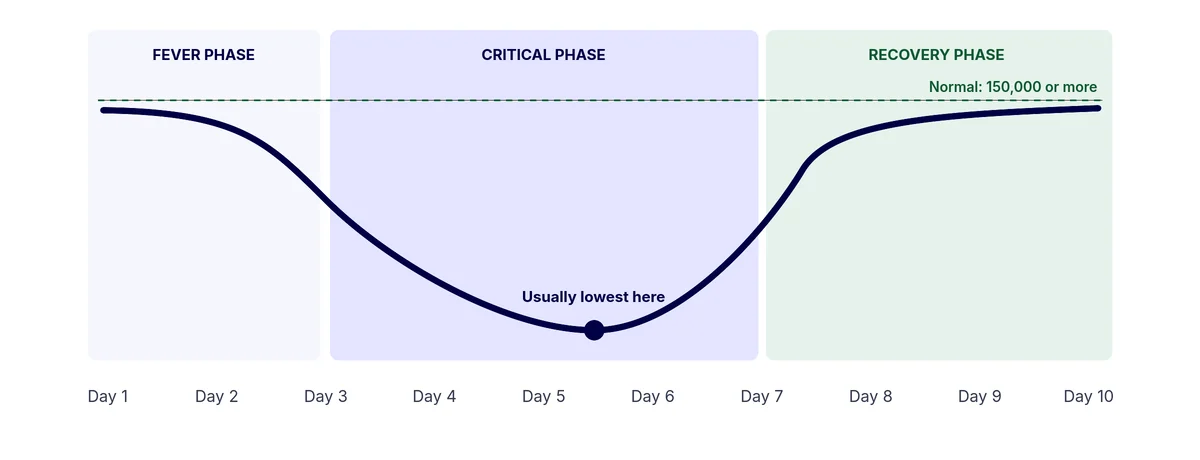
Days 1 to 3 bring the high fever, body aches and pain behind the eyes. Platelets are often still normal here, which gives false comfort.
Days 3 to 7 are the critical phase. The fever often drops and the patient says they feel better. Families relax, yet this is exactly when platelets tend to hit their lowest point and warning signs can appear.
From around day 7, appetite returns and counts climb back over the next few days. Some people notice an itchy rash on the hands and feet during recovery, which is usually harmless.
Remember: the fever breaking is not the finish line. Keep testing and keep fluids going for at least 48 hours after the temperature settles.
How Often Should You Check Platelets During Dengue?
Your doctor sets the schedule. Still, this is the pattern most of our patients in Gujranwala are given:
- Day 2 or 3 of fever: one CBC as a baseline, so later results have something to compare against.
- Critical days (roughly days 3 to 7): a platelet count or CBC every 24 hours. Admitted patients with fast falling counts are sometimes checked twice a day.
- Recovery: one follow up test once the count is clearly climbing, to confirm the trend.
Try to give the sample at about the same time each day. A morning routine works well for most families. When our phlebotomist arrives at your home at 9 AM (no fasting needed), the report reaches your WhatsApp the same day and your doctor can review it by evening.
CBC or Platelet Count Alone?
A Complete Blood Count (CBC) shows platelets plus hematocrit and white cells, which together tell your doctor far more. Low white cells and a rising hematocrit are both classic dengue clues.
A standalone Platelet Count suits daily tracking once your doctor already has the full picture and only wants the platelet trend. Unsure which one to book? Send us the prescription on WhatsApp and we will check it with you.
Reading Your Report: The Trend Beats the Number
One result on its own says little. A drop from 140,000 to 120,000 over two days is gentle, while a drop from 140,000 to 60,000 overnight needs your doctor today, even though 60,000 might sound manageable.
Check the hematocrit (HCT or PCV) line on your CBC as well. When it rises while platelets fall, fluid may be leaking from the blood vessels, and doctors take that seriously.
Occasionally a sample clumps in the tube and shows a falsely low count. If a result does not match how the patient looks, a repeat test settles it. Testing at the same lab each day also helps, because different machines can give slightly different numbers (we explain why in why test results can differ between labs).
Warning Signs: Go to Hospital Today
Whatever the platelet number says, take the patient to the nearest hospital emergency straight away if you notice any of these:
- Severe or constant belly pain
- Vomiting that will not stop, or not keeping any fluids down
- Bleeding from the gums or nose, blood in vomit, urine or stool, or black stool
- Unusual sleepiness, confusion or restlessness
- Cold, clammy hands and feet, or fast breathing
- Very little urine, or none for 6 hours or more
- A platelet count below 20,000
What Helps at Home, and What Does Not
Fluids are the single most useful thing you can give. Water, ORS, fresh juices, soups and lassi all count. A good sign is the patient passing urine every few hours.
For fever and pain, use paracetamol (such as Panadol) at the dose your doctor gives. Avoid aspirin (Disprin), ibuprofen (Brufen) and diclofenac, because they can raise the risk of bleeding.
Papaya leaf juice, kiwi and goat milk come up in almost every household. A few small studies on papaya leaf look interesting, but none of these replace fluids, testing or a doctor, so check with your doctor before relying on them.
Platelet transfusions are another common worry. Doctors decide on this based on bleeding and the overall picture, not one low number, and most dengue patients recover without one.
Getting a Platelet Count in Gujranwala Without Leaving Bed
Nobody with dengue should be sitting in G.T. Road traffic for a blood test. Book free home sampling and our certified phlebotomist will collect the sample at your door, whether you live in Satellite Town, Peoples Colony or anywhere else in our service areas.
Prefer to walk in? No appointment is needed at any of our branches.
Reports arrive on WhatsApp the same day, ready to forward to your doctor. One honest note: our dengue NS1 and antibody panel is paused at the moment, but CBC and platelet counts run at every branch as usual.
Frequently Asked Questions
What platelet count is dangerous in dengue?
No single cut off applies to everyone. As a general guide, counts below 50,000 need daily review by a doctor, and counts below 20,000 or any bleeding need hospital care straight away.
How long do platelets take to recover after dengue?
Most patients see platelets start rising within 2 to 3 days after the critical phase, and return to normal within about a week to 10 days. Your doctor may ask for one follow up test to confirm.
Do I need to fast before a platelet count or CBC?
No. Eat and drink normally. Keeping up fluids actually makes the blood draw easier.
Can platelets drop even after the fever goes away?
Yes, and this catches many families off guard. The lowest counts often come in the 24 to 48 hours after the fever breaks, so keep testing as your doctor advises.
Can a platelet count confirm dengue?
No. A low count with fever is a strong clue, but dengue is confirmed with specific tests such as NS1 or dengue antibodies. Fever with low counts can also come from malaria or typhoid, which is why doctors sometimes check for those too.
How much does a platelet test cost at City Care Lab?
Current prices are on the Platelet Count and CBC test pages, and home sample collection is free in our service areas.
If someone at home is on day three of a high fever, do not wait for things to settle on their own. Book a CBC today, keep the fluids going, and keep your doctor in the loop.
This guide is general health information from the City Care Lab team in Gujranwala. It does not replace advice from your own doctor.